140989/2072/073


A glacial collapse registering as a magnitude 5.2 seismic event occurred near the border on Wednesday morning
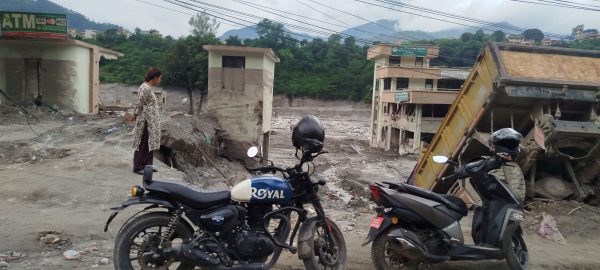
Scientists are starting to piece together the possible causes of the devastating Nepal-Tibet flash floods, which have killed hundreds[/caption]
What happened in Nepal ? Scientists are starting to piece together the possible causes of the devastating Nepal-Tibet flash floods, which have killed hundreds.
On Wednesday morning local time, a landslide of ice and rock resulted in a torrent of mud, water and debris bursting the banks of the Trishuli River, also known as the Bhotekoshi, which runs between China and Nepal. Homes, roads, bridges and power plants were swept away.
Experts at the Kathmandu-based International Centre for Integrated Mountain Development said water levels on the Trishuli River rose by as much as nine metres in half an hour. The Lhende Khola River, a tributary of the Trishuli, was most affected, they said.
Nepal’s foreign minister, Shisir Khanal, told the country’s parliament on Wednesday that initial reports suggested the floods could have been caused by an earthquake in the area that triggered a landslide.
However, the US Geological Survey (USGS) subsequently said that a glacial collapse was responsible for the seismic event and for the flooding itself.
The USGS noted that the glacial collapse had registered as a magnitude 5.2 seismic event, occurring near the border between Nepal and China at 8.37am local time on Wednesday.
According to Daniel Shugar, a geomorphologist and associate professor at the University of Calgary in Canada, initial satellite analysis showed a 0.2 sq km chunk of ice had “collapsed about 1.2km vertically”.
“What I can see in … satellite imagery from Planet Labs, the lower part of a glacier broke off at about 5,200 metres and crashed on to the valley floor about 1,200 metres below,” he said.
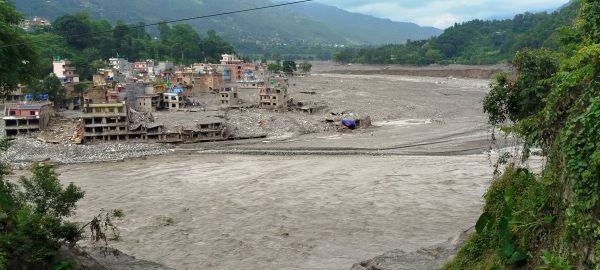
catastrophic flood in Nepal
“These sorts of large glacier collapses are really shocking,” Mackintosh said. “It’s hard as a glaciologist not be alarmed by these events that seem different to what we’ve observed previously.”
However, he said there had been “so few of these documented that we’re not really able to make very clear statements about the specific relationship between glacier collapse and climate change yet”. Scientists do, however, “have very high confidence in the relationship between glacier retreat and climate change”.
“We also know that mountain permafrost is degrading under a warming climate,” Mackintosh added. He described permafrost, ground that is frozen year round, as being akin to a “glue that holds the rock and sometimes adjacent glaciers … together on very steep slopes”.
The UN said in 2023 that Nepal’s mountains had lost close to one-third of their ice in just over 30 years due to global heating. An assessment published that year found that the Hindu Kush Himalayan glaciers had disappeared 65% faster between 2011 and 2020 than in the previous decade.
In 2021, a Himalayan glacier broke off and caused flash flooding in the Indian state of Uttarakhand, leaving 200 people dead or missing. Subsequent research suggested that a 27m-cubic-metre avalanche of rock and glacier ice had transformed into “an extraordinarily large and mobile debris flow”.
Though not thought to be a cause of the August 2026 event, mountain areas are also at risk of “glacial lake outburst floods”.
Glacial lakes form behind natural dams as a result of glacier melt, and can cause catastrophic outburst floods if their natural dam walls are breached.
Adrian McCallum, a glaciologist, polar engineer and associate professor at the University of the Sunshine Coast in Australia, said: “With a warming climate, glaciers recede, ice becomes water, that water gets trapped.”
More than 12,000 deaths have already been attributed to such floods globally. According to the UN, Nepal has more than 2,000 glacial lakes, of which 21 are considered potentially dangerous.